Motherless love: what research tells us
- Jessica Atkins

- 2 days ago
- 2 min read
From Bowlby's foundational work to modern neuroscience, decades of evidence reveal how maternal deprivation and abuse shape children's brains, behavior, and life outcomes — and what can be done about

Defining the problem: absence, neglect, and abuse
“Motherless love” refers not only to the physical absence of a mother, but also to the emotional absence that can occur through neglect, abuse, or untreated mental illness. Research distinguishes between maternal death, maternal abandonment, and the more complex category of “present-but-absent” mothers — those who are physically there but emotionally unavailable due to depression, addiction, or trauma.
John Bowlby’s landmark “44 Thieves” study found that among juvenile delinquents with affectionless psychopathy, the vast majority had experienced prolonged maternal separation in their first two years of life — establishing an early empirical link between maternal loss and behavioral outcomes.

Types of child maltreatment: the breakdown
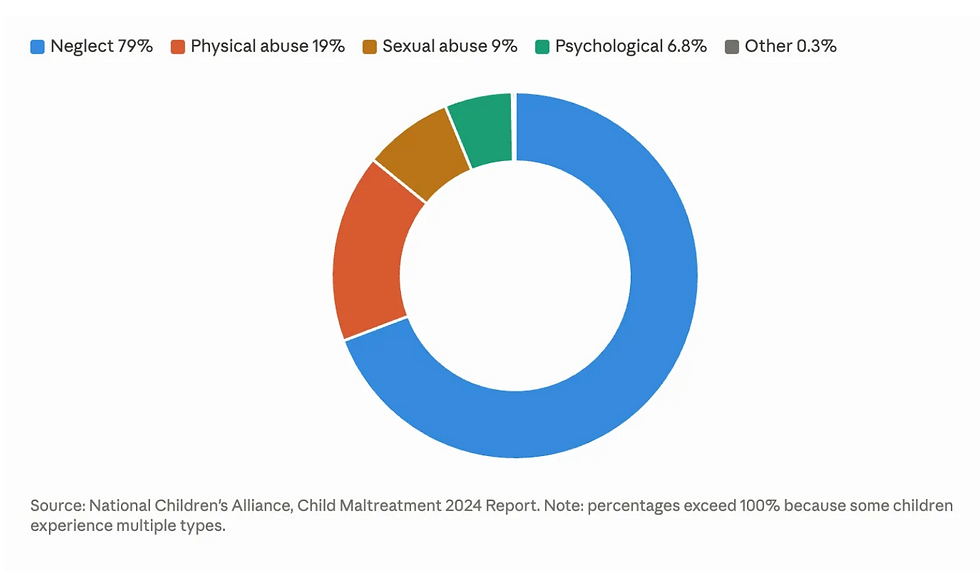
Neglect dominates the statistics, but physical and sexual abuse carry their own serious consequences. The chart below shows the distribution of maltreatment types nationally.
The neuroscience: what abuse does to the developing brain
Modern neuroimaging has confirmed what decades of attachment theory predicted. Children of mothers who experienced worse mental health after birth show measurably weaker connectivity between the amygdala and the prefrontal cortex — the neural pathway critical for emotion regulation. This reduced connectivity creates lasting vulnerabilities to anxiety, depression, and impulsive behavior.
Early life adversity also alters BDNF (brain-derived neurotrophic factor) expression and methylation in the prefrontal cortex — changes associated with mood disorders that can be passed to the next generation. Toxic stress from abuse physically damages brain architecture, making it harder to learn, focus, or feel safe.

Intergenerational transmission of trauma
One of the most significant — and sobering — findings is that trauma can travel across generations. Mothers who experienced childhood neglect show elevated anxiety and depression during pregnancy and after birth. That maternal mental health, in turn, is linked to higher rates of anxiety, depression, and social withdrawal in their children by age 7–8.
This does not mean the cycle is inevitable. The research is clear that supportive interventions — therapy, stable substitute caregivers, and strong social networks — can and do break this chain.

Behavioral and social consequences
The downstream behavioral impacts of maternal deprivation and abuse are wide-ranging. Children who experience neglect show delayed intellectual development, lower IQ scores, and reduced social engagement. Those with abusive histories are significantly overrepresented in the criminal justice system — 14% of incarcerated men and 36% of incarcerated women in the U.S. report childhood abuse, roughly twice the rate in the general population.

Protective factors & what works
The research is not without hope. Substitute caregiving — whether from a father, grandparent, or consistent mentor — can significantly buffer the effects of maternal absence. Early therapeutic intervention, stable school environments, and access to mental health support are all evidence-based buffers. Preventing ACEs (Adverse Childhood Experiences) could reduce cases of adult depression by up to 78% and suicide risk by up to 66%.
Children’s Advocacy Centers served over 372,000 children in 2024, providing trauma-informed care, forensic interviews, and family advocacy — an example of systemic response that the research shows makes a measurable difference.


Comments